Selecting the Right Framework for AI Agent Automation and Workflow Orchestration


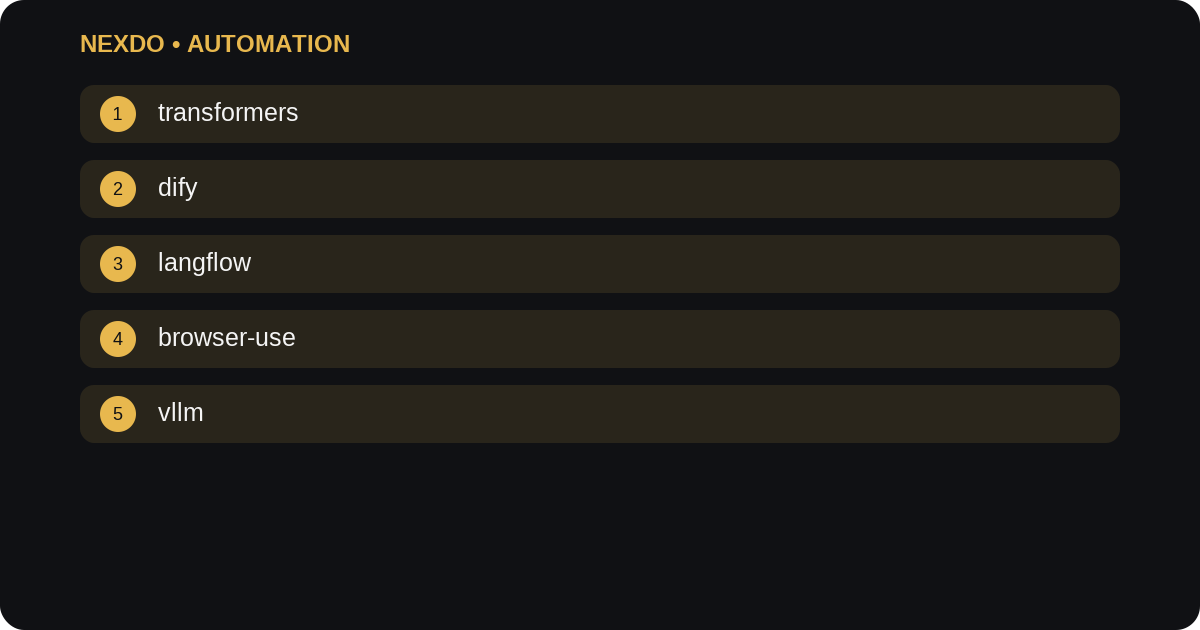
As organizations move from experimental AI prototypes to production-grade automation, selecting the correct infrastructure becomes critical. This editorial examines five prominent open-source projects—Transformers, Dify, Langflow, browser-use, and vllm—to help you determine which tool fits your specific technical requirements for agentic workflows and model serving.
Foundational Model Frameworks
When building custom AI solutions, the Transformers library serves as the bedrock for model definition. It provides the essential framework for state-of-the-art machine learning models across text, vision, and audio modalities. Whether you are focusing on inference or training, Transformers offers the flexibility required for deep customization. Unlike higher-level orchestration tools, this library is best suited for developers who need granular control over the underlying model architecture and data processing pipelines before integrating them into larger automated systems.
Orchestrating Agentic Workflows
For teams prioritizing collaborative workspace environments and rapid deployment, Dify and Langflow offer distinct advantages. Dify is designed to build agentic workflows and RAG pipelines with extensive support for various AI models and tools. Its ability to be deployed on cloud, VPC, or self-hosted environments allows teams to transition from prototype to production without rebuilding their stack. Similarly, Langflow provides a powerful interface for building and deploying AI-powered agents, making it an excellent choice for teams that prefer visual or modular workflow construction.
Specialized Browser and Inference Engines
Automation often requires interacting with external web environments or serving models at scale. The browser-use library addresses the former by providing an open-source Python solution for AI browser agents, including options for stealth browsers and hosted APIs. On the infrastructure side, vllm serves as a high-throughput and memory-efficient inference engine. By focusing on the serving layer, vllm ensures that your automated workflows remain responsive even under heavy load, making it a vital component for production-ready AI applications.
Compatibility and Integration Trade-offs
Selecting the right tool requires balancing ease of use with technical depth. Dify and Langflow are optimized for workflow orchestration, abstracting away some of the complexity found in raw model management. In contrast, Transformers requires a deeper understanding of machine learning internals but offers unmatched versatility. When integrating these, consider whether your project needs a full-stack orchestration platform like Dify or a specialized engine like vllm to handle the heavy lifting of model serving. Compatibility depends heavily on your existing infrastructure and team expertise.
Methodology for Tool Selection
Our selection process evaluates these tools based on their primary functional domain: model definition, workflow orchestration, browser interaction, and inference serving. We categorize these projects by their intended use case to ensure that developers do not conflate high-level agent builders with low-level model engines. By assessing the specific strengths of Transformers, Dify, Langflow, browser-use, and vllm, we provide a structured approach to building a robust AI stack that aligns with your specific automation goals and deployment constraints.
Tools compared
- transformers — Project / see requirements
- dify — Project / see requirements
- langflow — Project / see requirements
- browser-use — Project / see requirements
- vllm — Project / see requirements
Sources and verification
By aligning your project needs with the specific strengths of these open-source tools, you can build a resilient AI infrastructure that scales from initial development to production.