Selecting the Right MCP Server for Your AI Agent Infrastructure


As the Model Context Protocol (MCP) ecosystem matures, developers face a growing array of specialized servers designed to bridge AI agents with external data and tools. Choosing the right infrastructure requires balancing specific needs like code intelligence, web scraping, or multimedia processing. This guide evaluates five prominent MCP implementations to help you determine which tool best fits your architecture, focusing on their unique capabilities and integration strengths.
Deep Code Intelligence with codebase-memory-mcp
For developers prioritizing deep repository understanding, codebase-memory-mcp stands out by creating a persistent graph of code, documentation, and infrastructure. Unlike generic tools, it offers CBM Lens and change-aware test selection, making it an essential choice for maintaining context in complex projects. By integrating directly with your codebase, it allows AI agents to navigate internal logic with high precision. This is the ideal selection if your primary goal is to turn your local repository into a searchable, intelligent memory bank for automated coding tasks.
Scaling Automation with activepieces
When your objective is broad workflow automation, activepieces provides a robust framework with access to approximately 400 MCP servers. This extensive library makes it a powerhouse for connecting AI agents to various third-party services and internal workflows. While other tools focus on specific data types, activepieces excels in versatility, allowing you to orchestrate complex sequences of actions. It is the most suitable choice for teams that need a centralized hub to manage diverse AI agent tasks without building custom integrations for every single service.
High-Performance Search and RAG with xerj
The xerj project offers a unique approach by providing a single Rust binary that acts as an AI search engine and MCP server. It is designed for high-performance indexing of diverse formats including code, logs, JSONL, CSV, and PDFs. By supporting BM25 full-text, vector, and hybrid search, it serves as a powerful backend for RAG (Retrieval-Augmented Generation) and agent memory. If your infrastructure requires fast, Elasticsearch-compatible API access to large corpora of reference data, xerj provides the necessary speed and flexibility.
External Data Extraction via apify-mcp-server
The apify-mcp-server is specifically engineered to bridge the gap between AI agents and the live web. By leveraging the vast Apify Store, it enables agents to extract data from social media, e-commerce platforms, maps, and search engines. This tool is indispensable for agents that require real-time external information to function effectively. Rather than focusing on internal code or document indexing, it acts as a gateway to the internet, making it the primary choice for research-heavy or market-analysis AI agent workflows.
Multimedia Processing with autoclip
For specialized tasks involving video content, autoclip offers a local-first approach to AI-driven clipping. It automates the process of turning long-form content like podcasts or lectures into short-form videos, complete with subtitles and metadata. As an MCP server, it allows agents to trigger video processing tasks programmatically. This is the most suitable tool for content creators and media-focused teams looking to integrate automated video editing into their AI agent pipelines without relying on subscription-based cloud services.
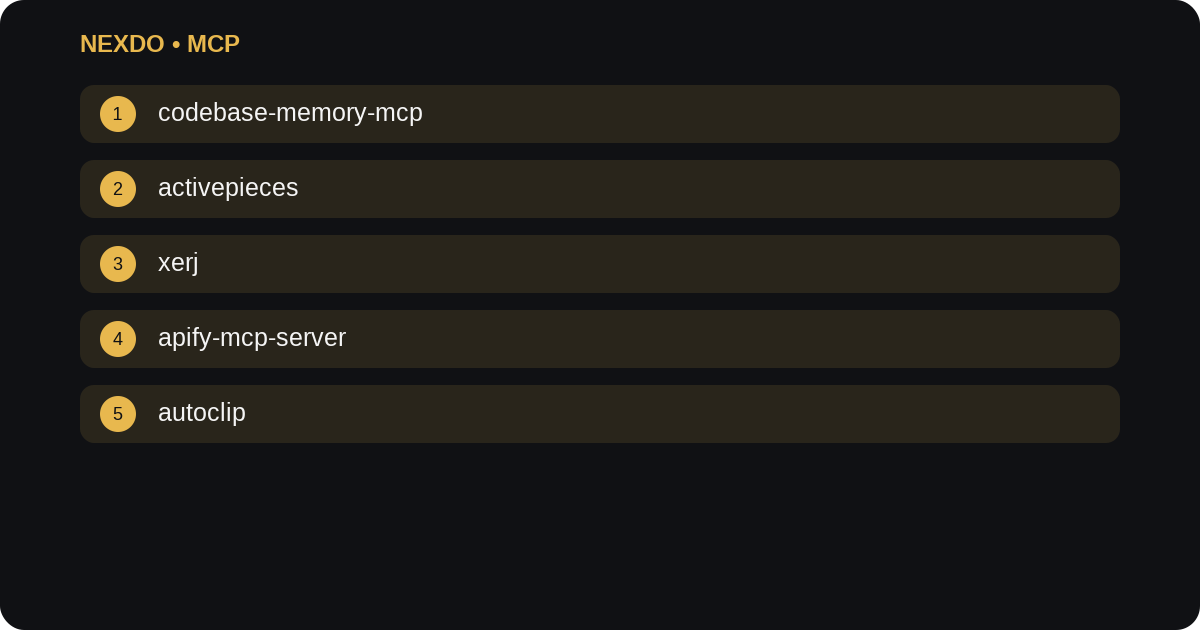
Tools compared
- codebase-memory-mcp — MCP / see setup
- activepieces — MCP / see setup
- xerj — MCP / see setup
- apify-mcp-server — MCP / see setup
- autoclip — MCP / see setup
Sources and verification
Selecting the right MCP server depends on whether your agents need to analyze internal code, scrape the web, or process media. By matching the specific strengths of codebase-memory-mcp, activepieces, xerj, apify-mcp-server, and autoclip to your project requirements, you can build a highly efficient and context-aware AI ecosystem.